Students can’t learn in cultures of perfectionism or opting out
In my work with schools, I often talk about the importance of building a Culture of Error: a classroom where students understand that making mistakes is part of learning, and that learning necessarily involves some vulnerability. You have to put yourself out there a little bit. You have to attempt something before you are completely certain, and reveal what you know and, inevitably, what you don’t yet know.
That sounds obvious. But increasingly, I think there are two competing cultures creeping into our classrooms that make this surprisingly difficult.
The first is a culture of opting out. When something is difficult, uncomfortable, or simply not what I feel like doing, I don’t have to try. The second is a culture of perfectionism. I want to succeed, but I’m so worried about getting something wrong—or about other people discovering that I don’t know something—that I’d rather not put myself out there in the first place.
One says, I don’t want to do it. The other says, I don’t want to do it unless I know I’ll get it right. The result can be remarkably similar: inaction.
And you can’t learn if you don’t try.
Learning requires (more than) a little vulnerability
There is no serious version of learning that eliminates the possibility of being wrong. Students have to attempt the unfamiliar word, offer the tentative answer, write the imperfect sentence, test the hypothesis, solve the problem and occasionally discover that their thinking doesn’t quite work.
Without that vulnerability, teachers are effectively teaching into the dark. We can’t respond to misconceptions we can’t see, and we can’t give useful feedback if students won’t show us their thinking. Otherwise, it all comes out in the wash later: in an assessment, a piece of writing or a test at the end of the week, when we suddenly discover that students hadn’t understood nearly as much as we thought.
This is why Doug Lemov’s work on a Culture of Error is so important. In Teach Like a Champion, the goal isn’t simply to reassure students that mistakes are okay. It is to establish a classroom where errors can be surfaced, examined and corrected because students understand that being wrong is a normal and productive part of getting better.
Wrong isn’t the opposite of learning. Very often, wrong is part of the journey towards right.When childhood becomes an optimisation project
There is also a wider cultural context that schools can’t ignore. Parents naturally want their children to be safe and happy, and that’s a good instinct. But I worry about what happens when safety gradually expands to mean freedom from discomfort, challenge, disappointment, embarrassment or failure.
A difficult conversation becomes something to avoid. A correction becomes harmful because it made a child uncomfortable. Being expected to speak, perform or attempt something publicly becomes something from which a student should be protected. Yet the purpose of teaching cannot always be to keep students comfortable.
Education can’t—and shouldn’t—promise a life free from discomfort. Part of our responsibility is to help young people discover that they can experience manageable discomfort, persist through it and emerge successfully on the other side.
That doesn’t necessarily mean throwing students straight into the deep end. If I’m asking a student to pronounce an unfamiliar technical word, for example, I might first pronounce it with the whole class. We might rehearse it together, turn to a partner and use it, and only afterwards ask students to share individually. We don’t eliminate the challenge; we engineer success through the challenge.
There is another version of childhood optimisation that looks almost like its opposite: relentless pressure to succeed. Every grade matters, every performance matters, and every opportunity needs to be maximised. Here we can produce the perfectionist student: conscientious, motivated and perhaps highly successful, but increasingly unwilling to attempt anything at which they might not immediately excel.
That can follow young people well beyond school. If your identity becomes wrapped up in always getting things right, ordinary experiences of adult life—criticism, uncertainty, setbacks, compromise, being a beginner again—can become disproportionately threatening. Strangely, then, overprotection and over-expectation can arrive at the same destination: if success isn’t guaranteed, don’t try.
We need a healthier message. Making mistakes is part of learning. Practice doesn’t make perfect; practice makes progress. Don’t aim for perfection: aim for good, and then aim for better. Perfection is the enemy of the good.
And above all: you can’t learn if you don’t try.A Culture of Error is something we do
These ideas can’t simply become slogans on classroom walls. A Culture of Error has to become visible in the daily practice of a classroom.
One example I share with schools comes from a teacher who begins lessons by identifying some of the misconceptions students are likely to encounter. Rather than hiding errors, she brings them into the open from the beginning. Then, when one appears during the lesson, it becomes something worth investigating: There it is. Why is that such an easy mistake to make? What happened in our thinking? What do we need to change?
The important thing is that standards haven’t disappeared, hidden to avoid being found out. We aren’t pretending an incorrect answer is correct; we are teaching students that an error is something to investigate, correct and learn from, rather than something to conceal.
A response might be: That’s interesting. Let’s look at how you got there. Or: You’ve got one part of it. What needs to change? This separates two ideas that students too easily conflate: ‘I made an error’, and ‘I must be a failure’. The first is inevitable in learning; the second doesn’t follow from it.
Participation is the gateway
This connects to a progression I use frequently in my work with schools:
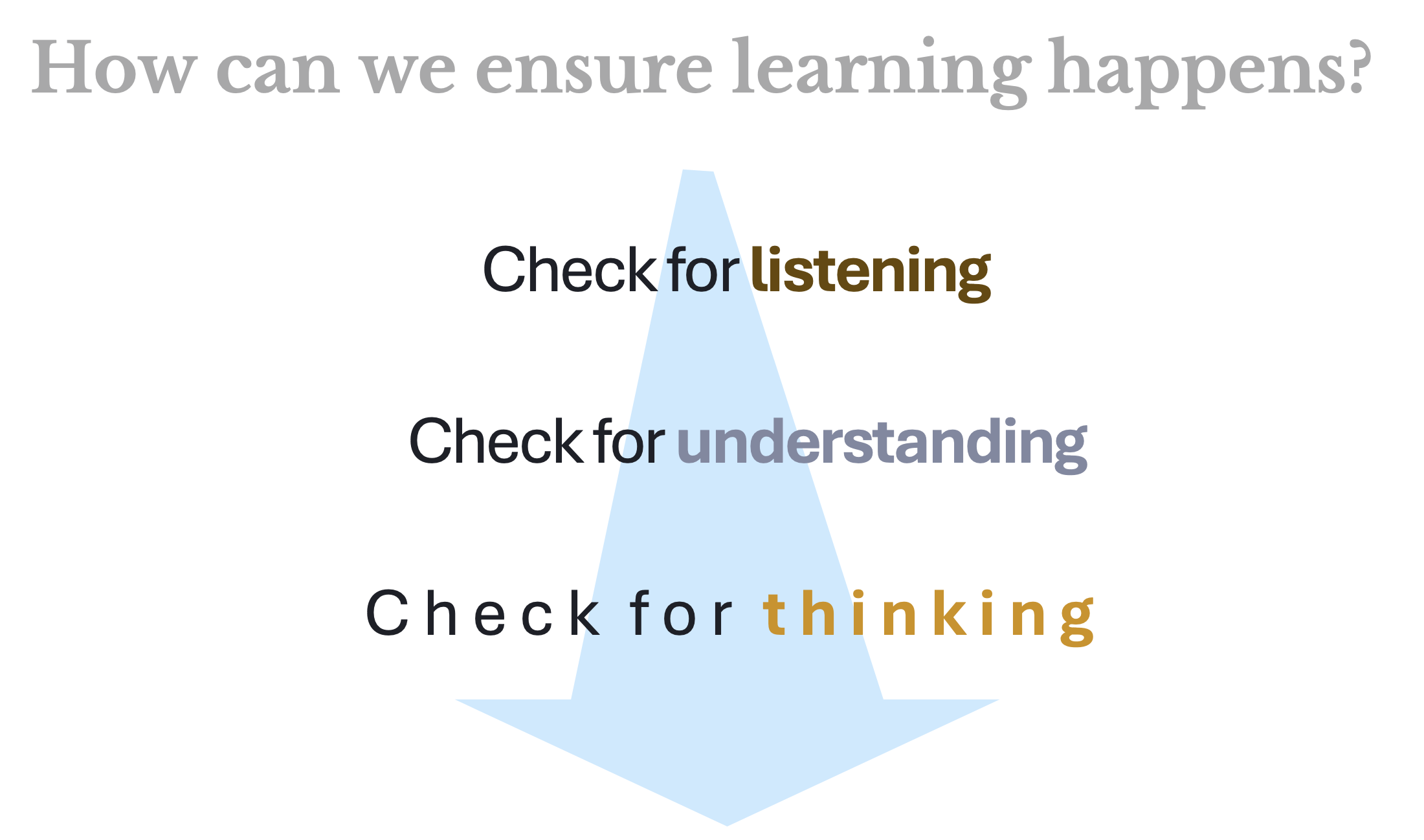
Listening → understanding → thinking.Ultimately, we want students doing sophisticated things. We want them questioning, analysing, connecting, arguing, creating and thinking critically. But the sequence matters: students can’t think critically about something they don’t understand, and they can’t understand what they haven’t attended to in the first place.
Listening and participation are therefore the gateway to understanding, which is the gateway to generative, critical and creative thinking. Participation isn’t merely a cosmetic feature of an energetic classroom; it is part of the mechanism through which learning happens.
Teaching is more than delivering information
Some teachers I work with are understandably worried that asking students to respond might make them anxious. There can also be an implicit view that our professional responsibility is to deliver the curriculum clearly and accurately, whether students actually engage with it or not— a decision left up to them.
But this risks kicking the can of participation down the road. If a student can spend lesson after lesson physically present but intellectually absent—rarely expected to answer, explain, practise, read, write, discuss or otherwise reveal their thinking—then school can become a remarkably meaningless and wasteful period of their life. Six years of secondary schooling is an enormous investment of a young person’s time. Simply being in the room while information is delivered isn’t enough.
This is why I think we need an important distinction between delivering information and teaching. Teaching isn’t simply the act of transmitting content. It is the work of helping that content take up residence in the learner’s mind and become available for later use. That means paying attention to whether students are listening, whether they understand, whether they can retrieve and apply what they have learned, and ultimately whether they can do something more interesting with it.
Of course, teachers cannot literally force learning to occur. Students ultimately have to choose to join in, and there will always be limits to what any teacher can achieve. But that doesn’t absolve us of responsibility for creating conditions in which participation is expected, supported and difficult to continually avoid.
This is particularly important when anxiety is raised as a reason not to ask students to respond. We should absolutely design participation carefully: rehearse before cold calling, use pair-share, choral response and mini-whiteboards, build predictable routines, and avoid deliberately or inadvertently embarrassing students for mistakes. But there is a profound difference between supporting a student through the manageable discomfort of participation and teaching them that discomfort is a reason to opt out of it.
If students don’t choose to l opt in and managed to earn what we teach them, then in an important sense, we haven’t really taught at all. We may have explained. We may have presented. We may have covered the curriculum. But teaching has to be concerned with what happens at the other end of the process. It should always be a dynamic dialogue and not ever a one-way delivery.
That is why participation matters so much. It isn’t about compliance for compliance’s sake. It is one of the principal ways we reveal and verify student understanding so that we can ensure it is secured.
“Teenagers are just difficult?”
Another sentiment that gets thrown around when teachers decry a lack of engagement is that teenagers are just difficult, or that young people simply don’t learn like they used to. There are undoubtedly changes in how some students arrive at school ready—or not particularly ready—to learn. Their intrinsic motivation for the content can vary enormously, as can their confidence in themselves, their capacity to sustain attention, and the community and family support around them.
Some of these changes extend well beyond anything a teacher can control. Consider, for example, the apparent trend towards family members eating meals individually, sometimes in separate rooms, rather than coming together around the dinner table for what has traditionally been an important touchstone of the day. Whatever the causes, schools inevitably inherit the consequences of broader changes in family life, technology, social interaction and childhood.
But there is a point at which describing those changes becomes an excuse for accepting them.
We can’t change students’ childhoods, but we can change how they spend their time at school. We don’t have to accept a caricature of teenagers as inevitably reluctant, disaffected and disinterested young people who will participate only when teachers somehow manage to trigger a surge of personal interest. We can instead require an acceptable level of oomph to be part of the learning community: and that students will listen, and think hard, that they attempt things, and that students will contribute something to the collective endeavour.
This can seem almost impossible in the secondary space when a whole-school culture of opting out has already become established, or when students are stifled by perfectionism and reluctant to expose what they don’t know. If every classroom has developed different expectations and students have spent years learning that participation is negotiable, no single teacher is going to transform that culture overnight.
And that is where we will leave our discussion until part two…In sum, a culture of error and ultimately a culture of curiosity isn’t something that you inherit from the students who arrive. If you want your classroom to be a place of genuine involvement, understanding, and ultimately critical and creative thinking, the small acts of requiring Student participation by embedding what should become engagement norms could be the missing ingredient to shift the dial.
Remember!
Practice doesn’t make perfect.
Practice makes progress.
And students can’t learn if they don’t try.
Tune in next week to hear how this change is only possible if we all work together so that sub-optional norms are not what you must accommodate, but that instead the replacement cultures of error and curiosity are something we intentionally cultivate.

Want to go deeper?

Unlocking Literacy: Unlocking the Power of Words for Reading and Spelling
This is a new Luminary Specialist Course with Dr Nathaniel Swain.
Across four 90-minute live webinars, we'll take a deeper dive into the knowledge and instructional techniques that help students become increasingly capable readers and spellers.
Live webinars: 5, 12, 19 & 26 October 2026 at 6:30 pm AEDT
Recordings: Available for three weeks following the final webinar
Places are limited.

Literacy Across the Curriculum — Melbourne, Sydney & Sunshine Coast
I'll also be running Literacy Across the Curriculum full-day professional learning workshops in Melbourne, Sydney and the Sunshine Coast.
Designed for primary and secondary teachers and leaders, these practical workshops explore how we can embed powerful reading, writing and oracy instruction across the curriculum—helping students access complex texts and concepts, develop disciplinary literacy and communicate increasingly sophisticated ideas.
Melbourne & Sydney — Nov 2026
Mon 2 Nov 2026 - Sydney
Mon 30 Nov 2026 - Melbourne
Sunshine Coast — Jan 2027
Fri 22 Jan 2027 Pacific Paradise State School
These workshops bring the same principle to life: strong literacy foundations don't narrow the curriculum—they give students greater access to it.
Places are limited.

Keep learning with Luminary
Bite-sized professional learning. Practical ideas. Available anytime.
Luminary gives teachers and school leaders access to practical, evidence-informed professional learning designed to support classroom practice and whole-school improvement.
Explore short, focused learning on explicit teaching, literacy, cognitive science, curriculum, assessment and more — and turn the research into approaches you can actually use.
Learn at your own pace. Revisit ideas when you need them. Put them into practice straight away.
Whether you're looking for a quick boost for tomorrow's lesson or supporting longer-term improvement across your school, Luminary makes high-quality professional learning available when it matters.
Learn. Apply. Improve.
Find out more!