The magic of learning together: Small acts that can move mountains
A school forms a distinct culture whether we deliberately shape it or not. In this series of posts, I have been examining why we need to shift our school and classroom culture to benefit the learning of staff and students.
Your school could uphold a Culture of Error, where mistakes are expected and used for learning, and a Culture of Curiosity, where students are motivated to always wonder about what they can learn next. But, if we are not careful, schools can also form Cultures of Opting Out and Perfectionism, where the safest course is not to expose your thinking at all.


In the other posts in the series, I have worked to problematise norms of ‘opting out’ and of ‘perfectionism’, and investigated what it would take to make such changes across many classrooms throughout a school. Such work is no mean feat… But maybe it can start with something small?
Here we will examine how small acts of participation, repeated over time, can turn hesitant learners into confident contributors.

What makes a culture
Successful school cultures aren’t created by mission statements or school assemblies alone. They are created by the thousands of tiny, seemingly inconsequential interactions students participate in across classrooms every week:
whether they are expected to answer;
what happens when they get something wrong;
whether a teacher comes back to them after I don’t know’;
whether effort results in progress; and
whether the adults around them communicate that learning is something in which students are unavoidably involved, and never just passive recipients.
The pulling power of involvement
There is another reason participation matters. Something special can happen when a classroom starts thinking together.
In many of the classroom examples I use in professional learning —including the lessons that I model and demonstrate with schools —students are constantly responding: talking with partners, answering questions, rehearsing vocabulary together and building on one another’s thinking. There isn’t room to opt out or worry about making mistakes.
When teaching new content, the teacher is unmistakably in control of the learning, while students are intimately involved. It isn’t grim or authoritarian, however: It’s warm, energetic and joyful.
There is a wonderful sociological term for this: collective effervescence. It’s that moment when we all are involved in the same feeling at the same time. Everyone remembers something relevant from last week. Several students suddenly see the connection. A difficult idea seems to click across the room at once. You can feel the energy change.
A student’s tentative answer unlocks someone else’s thinking. An error becomes an object of collective investigation. One student’s lightbulb moment sparks another’s.
If individualisation/personalisation were the only priority in education, we would justifiably put every student into a little cubicle with a laptop and an AI tutor. But classrooms offer us something more powerful: the opportunity for students to think with one another. That collective effervescence gives students an experience that turns learning in a group into an opportunity—and less of a one-size-fits-all compromise—a chance to achieve something meaningful and enriching together.
But it all depends on participation. You can’t harness the collective intellectual energy of the group whilst permitting a classroom culture in which half the students remain invisible or silent.

Collective effervescence doesn’t just emerge like a ‘Dead Poets Society’ moment
There is another misconception worth tackling here. When we imagine a deeply engaged classroom—a room full of students taking intellectual risks, questioning ideas, responding to one another and becoming swept up in the excitement of learning—it is easy to picture a poignant Dead Poets Society-esque moment: The charismatic teacher challenges students to question the very nature of their reality, throws off the shackles of traditional education, and suddenly everyone is standing on desks seeing the world anew.
Real classroom culture is built much less dramatically
When teachers see examples of collective effervescence in action, it can actually be quite difficult to unpack what got the class there. The end point looks impressive: students are excited, engaged, willing to answer, willing to challenge one another, and willing to learn from mistakes. But the beginning is often much smaller and less glamorous. It starts with tiny acts of participation.


A learning culture grows stronger when mistakes are noticed, discussed and used to point everyone toward a better path.
In my work with schools:
I talk about students pronouncing the words of the curriculum aloud; or reading stretches of text chorally as a group, or tracking while a teacher or another student reads
I talk about students capturing their thinking on mini-whiteboards, turning to a partner to discuss an answer, rehearsing a sentence before sharing it, or everyone responding chorally to an important idea.
None of this sounds particularly revolutionary. And in many classrooms around the English-speaking world—especially in secondary schools, but increasingly in upper primary too—the initial reaction can be exactly that: This is weird. How lame. Why should I have to do this?
Sometimes teachers feel the awkwardness just as much as the students. There can be a sense that surely nine-, ten- or eleven-year-olds are already ‘too old’ to be saying words together, reading chorally or making their thinking visible in such an overt way.
However, if we can get over that initial hurdle of awkwardness, these small moments of attention, focus and repetition can become the gateway to a very different culture of learning. The reason is cognitive as much as cultural. Attention is fragile, and working memory is easily overloaded. That is, a lack of participation could be a natural outcome of learning being, well, hard!
The two compromise-reactions to student non-participation
Without strong norms of participation and engagement, we run the very real risk—already the case in many classrooms—that students are barely listening to us, let alone understanding what we are teaching, let alone thinking critically about it.
This phenomenon of having too many ‘passengers’ cruising through your lessons usually produces two distinct but related compromises that the teacher makes when faced with this disengagement.
Reaction 1: content deliverer
I) One compromise-reaction is that the teacher changes their role from an ‘orchestrator of learning’, to more of a ‘content deliverer’ spending most of the time dumping content onto students before they try and make sense of it.
This first reaction takes the worst of explicit or direct approaches without due attention to student focus and working memory. It ignores the need for active participation and breaking up instruction into manageable chunks and practising between each step.
Reaction 2: outsourcer of insight
II) Another compromise-reaction is trying to avoid teaching via modelling and explanation, and instead reducing the first part of the lesson to a ‘mini-lesson’, followed by a heavy emphasis on independent work or collaborative problem-solving even if students are not ready for it.
This second reaction changes the teacher’s role again from ‘engineer of success’, to more of an ‘outsourcer of insight’, as students try to make sense of the task themselves or teachers reduce the complexity so students can do it independently… Neither of these two compromises are warranted or optimal.
How do we get out of here?
It doesn’t have to be this way! The solution to the lack of engagement is more nuanced, but also more effective. It’s all about the progression of checks for student participation and insight throughout the lesson which can engineer focus and success simultaneously. The teacher’s role is not simply to deliver content, nor to step back and ask students to inquire from scratch. Rather, the teacher needs to constantly ensure a continuity of successful student listening → understanding → thinking as each section of the lesson/unit unfolds.
If we want students to question, analyse, create and investigate, we first have to build conditions in which they are intellectually (and not just physically) present for the learning.

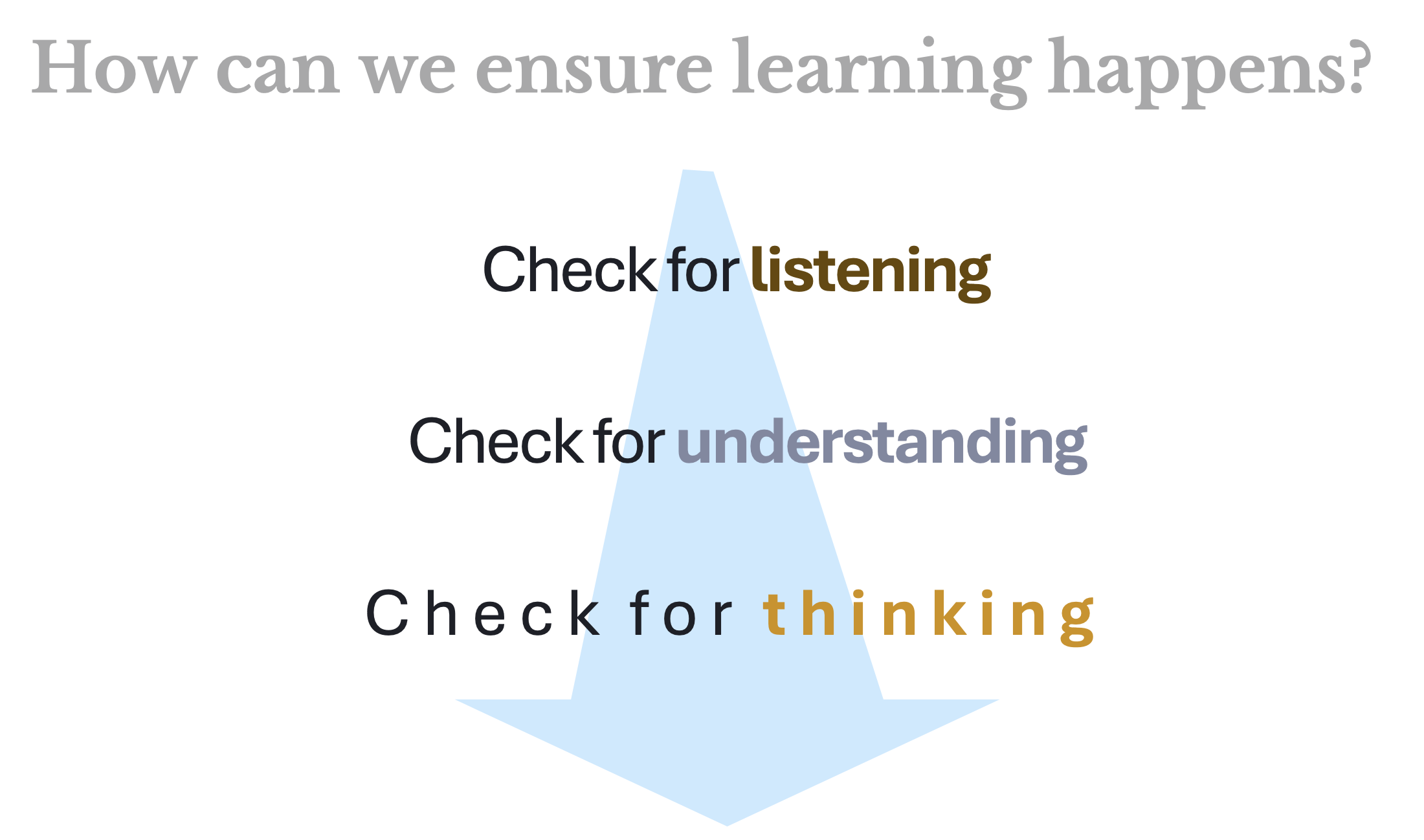
Thus, the following progression can be operationalised to change the culture of the classroom, and eventually the school.
Let us begin…
1. Checks for listening
Students pronouncing a term together or repeating a phrase may seem a trivial addition to your practice, but it requires attention. Choral reading too requires them to track the text. A mini-whiteboard or booklet response requires students to generate an answer, rather than merely listen to somebody else give one. A short pair share requires them to formulate and articulate an idea, or to prepare to report back on a peer’s.
These small and frequent checks that students are listening could also be referred to as engagement norms or opportunities to respond. Ideally, they happen every 30 to 40 seconds in the active teaching (I do, We Do) parts of your lessons. For example, you can teach students to use shared gestures for difficult terminology, and that when you pause in your explanation you are creating a ‘cloze sentence’ you want students to finish. If you have set up the norms, then you can embed these checks constantly throughout your explanation and modelling.
This is what makes the gestures and repetition are so helpful. Students get used to the idea that what you say and show matters as they may be asked to repeat or to fill in the blank when you give them the opportunity.
For example you might say the following to students at the end of an explanation:
Teacher: So in this example we have the case of ______
Students: homogenous groupings
And depending on their level of independence they can do this instantly when you pause for that blank. You can also use a gesture that is pre-established to cue them to fill in the correct response.
When you embed these checks for listening into the flow of the lesson, they actually take no extra time and they give you the reinforcement that students are listening and paying attention, and are ready if you wish to pivot to another kind of check a few minutes later. That is a ‘check for understanding’ and is where we will go next!
2. Checks for understanding
If you have checked that students are listening every 30 to 40 seconds through an opportunity to respond or engagement norm. The next step is to check if what you’ve shown or explained is making sense. Checks for understanding are designed to set up students to answer questions and perform tasks that allow us to verify that understanding is occurring.
We need to ensure we:
teach something first;
pose a specific question or task;
allow for thinking time (either through writing on a mini whiteboard, discussing in a pair share, or just a silent moment of contemplation);
get students to generate responses;
check those responses and make decisions about next moves; and
give in-the-moment feedback to close the loop.
All means all!
What’s critical here and what relates well to our discussion of the culture of error, is that students (and I mean all students) get the chance to respond and share their thinking. You can’t look past the power of pair shares, mini whiteboards, and cold call to allow this to happen. If we only hear from some voices, then not every voice matters. See the arguments outlined in part one.
What this does for culture: Small acts can move mountains
Each of the above acts are small, but each says something about the culture: you are part of this learning; your attention matters; your response matters; you are expected to do something with what is being taught.
Over time, those small acts accumulate. Students become less self-conscious about speaking. Routines become familiar. The effort required simply to participate starts to fall. Students hear more of one another’s thinking. They become more accustomed to revealing partial understanding, and therefore more accustomed to discovering and correcting errors.
3. Checks for thinking
If students have demonstrated that they are listening and understanding, then the stage is set for you to push them further. You can now deliberately provide provocations, nudges, or questions for which you have not directly prepared students. Here the aim is to challenge students to connect the dots themselves, come up with novel solutions or suggestions, or to share their opinions and perspectives on complex ideas. Often we want to rush to this kind of check for thinking, but this would be shortsighted.
Don’t rush to checks for thinking
Unless we have checked that students are listening and participating, and that they are ready to share their understanding or misunderstanding (and get the feedback to correct this or extend this further), there is no point throwing them straight into the deep end. Such premature checks for thinking result in inequity and piecemeal participation. Inadvertently, your classroom can become a place where some students who seem to know everything continue to shine; and where those students who don’t know everything (and won’t even try) disappear into the darkness. We can avoid this by first checking for listening and then understanding.
If you have done the groundwork (and are set up well for checks for thinking to land), then these open-ended or challenging questions/tasks have the potential to:

stretch your students’ thinking and test their assumptions;
encourage lateral or flexible thought and application;
build a culture of curiosity that creates a thirst for new understandings; and
draw out a diversity of viewpoints and opinions that would otherwise lie dormant.
The results of the small acts: The progression from listening → understanding → thinking
That is how we get closer to the classroom where a difficult idea suddenly clicks and the room comes alive. The collective effervescence is real, but it is rarely summoned by one spectacular speech. It is built through hundreds of ordinary moments in which students have learned that participation is simply what happens here.
Although the end point might be a class of excited and engaged students who willingly share their thinking and learn from mistakes, the starting point can be much more modest: the willingness to try, to say something, write something, show something, or share something with a partner or the class.
From error to curiosity



Remember that to avoid cultures of opting out or perfectionism, we need to instill a culture of error, where students are safe to make mistakes.
Perhaps the most important point to reiterate is that a Culture of Error isn’t the destination. It’s the foundation.
We want students to move from listening → understanding → thinking:
from being shown, to practising, to applying;
from answering our questions to generating their own; and
from following a model to making connections we haven’t made for them.
This is where explicit teaching and inquiry aren’t opposites at all. Novices benefit from clear explanations, step-by-step instruction, modelling, worked examples and plenty of practice—not because they are incapable of anything more sophisticated, but because they don’t yet possess the knowledge that makes sophisticated thinking possible.
As that knowledge develops—and students move from novice toward expert—the instructional response should change. We can pull back the reins. Students can connect more of the dots themselves: they can summarise, map, explain, compare, solve open-ended problems, create representations, deal with ambiguity and generate new questions.

As I often put it, explicit teaching isn’t about students regurgitating what we’ve told them. It’s about building foundations that allow them to make new connections, find new possibilities and generate new understandings.
We want students to explore, to be curious and to tackle things where the answer isn’t immediately obvious. But curiosity requires risk. Students have to be willing to wonder whether their idea will work, offer an interpretation that might be different, ask a question that might sound silly, or attempt something without knowing whether they will succeed.
A student trapped by perfectionism won’t go there, and a student accustomed to opting out will seldom muster the effort to try. In contrast, a student immersed in a Culture of Error just might, because gradually they have learned: I can try. I can be wrong. I can get feedback. I can change my thinking. I can get better.
The culture creates the outlook of the learner: Bringing it all together
Ultimately, the goal of this work is not a classroom without mistakes or discomfort. It’s a classroom (and ultimately a school) where students know what to do with the challenges (or should we say opportunities?) of feeling unsure if we are right or if we can do it.



If students manage to experience success—from incremental insights to profound pangs of insight—the result is a culture of participation rather than opting out, of progress over perfection, and learning from error that ultimately drives curiosity.
So start engaging students with the norm of participants and create that ‘magic’ by checking for listening → understanding → thinking. Learning together really does have a supernatural power. If you lean into the learning opportunity for you and your students, these small acts of participation will in fact move mountains.

Want to go deeper?

Unlocking Literacy: Unlocking the Power of Words for Reading and Spelling
This is a new Luminary Specialist Course with Dr Nathaniel Swain.
Across four 90-minute live webinars, we'll take a deeper dive into the knowledge and instructional techniques that help students become increasingly capable readers and spellers.
Live webinars: 5, 12, 19 & 26 October 2026 at 6:30 pm AEDT
Recordings: Available for three weeks following the final webinar
Places are limited.

Literacy Across the Curriculum — Melbourne, Sydney & Sunshine Coast
I'll also be running Literacy Across the Curriculum full-day professional learning workshops in Melbourne, Sydney and the Sunshine Coast.
Designed for primary and secondary teachers and leaders, these practical workshops explore how we can embed powerful reading, writing and oracy instruction across the curriculum—helping students access complex texts and concepts, develop disciplinary literacy and communicate increasingly sophisticated ideas.
Melbourne & Sydney — November 2026
New dates have been added.
Sunshine Coast — 22 January 2027
Pacific Paradise State School | 8:30 am–3:00 pm
These workshops bring the same principle to life: strong literacy foundations don't narrow the curriculum—they give students greater access to it.
Places are limited.

Keep learning with Luminary
Bite-sized professional learning. Practical ideas. Available anytime.
Luminary gives teachers and school leaders access to practical, evidence-informed professional learning designed to support classroom practice and whole-school improvement.
Explore short, focused learning on explicit teaching, literacy, cognitive science, curriculum, assessment and more — and turn the research into approaches you can actually use.
Learn at your own pace. Revisit ideas when you need them. Put them into practice straight away.
Whether you're looking for a quick boost for tomorrow's lesson or supporting longer-term improvement across your school, Luminary makes high-quality professional learning available when it matters.
Learn. Apply. Improve.
Find out more!